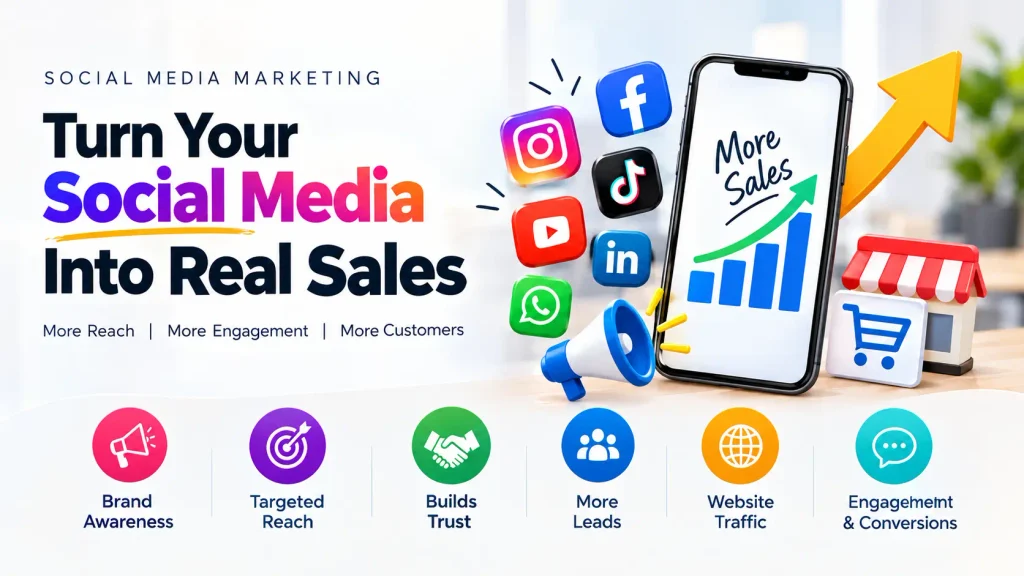
In today’s digital world, social media has become one of the most powerful tools for businesses to connect with customers, build their brands, and increase sales. Understanding How SMM Can Increase Business Sales helps businesses use platforms such as Instagram, Facebook, YouTube, TikTok, LinkedIn, and WhatsApp to reach potential customers directly and communicate with them in a more personal and engaging way.
Social media marketing is not simply about posting pictures or videos. It involves creating valuable content, understanding customer needs, building relationships, promoting products or services, and encouraging people to take action. When used strategically, social media marketing can help businesses attract new customers, retain existing ones, and generate consistent sales.
1. Increases Brand Awareness
The first step toward increasing sales is making people aware of your business. Social media provides businesses with an opportunity to introduce their products and services to a large audience.
Regular posts, reels, stories, videos, and advertisements can help customers recognize a brand. Even if someone does not immediately purchase a product, repeated exposure can make the brand familiar to them.
For example, a local furniture store can regularly share images and videos of sofas, beds, dining tables, and home interiors. Over time, people who see these posts may remember the store when they are ready to purchase furniture.
Greater brand awareness creates more opportunities for future sales.
2. Reaches the Right Target Audience
One of the biggest advantages of social media marketing is the ability to target specific audiences.
Businesses can create campaigns based on factors such as age, location, interests, behavior, and other audience characteristics. This allows advertisements to reach people who are more likely to be interested in the product or service.
For example, a clothing business in Thrissur can focus its advertising on people in nearby areas who are interested in fashion and shopping. Instead of showing an advertisement to everyone, the business can concentrate its marketing budget on a more relevant audience.
Targeted marketing can improve the efficiency of advertising and help businesses generate better-quality leads.
3. Builds Trust and Credibility
Customers are more likely to purchase from businesses they trust. Social media provides an excellent platform for building that trust.
Businesses can share customer reviews, testimonials, product demonstrations, behind-the-scenes content, company updates, and educational information. This gives potential customers a better understanding of the business.
For example, a bakery can post videos showing how cakes are prepared, decorated, and packaged. This type of content can demonstrate quality and professionalism while making customers feel more connected to the brand.
Authentic and consistent communication can help turn a business from an unknown company into a trusted brand.
4. Generates More Leads
Social media can be an effective source of leads for businesses. A lead is a person who has shown interest in a product or service and may become a customer.
Businesses can generate leads through advertisements, contact forms, direct messages, website links, WhatsApp buttons, promotional offers, and landing pages.
For example, a digital marketing agency could run an advertisement offering a free consultation. Interested business owners can click the advertisement, submit their details, or contact the agency through WhatsApp.
These interactions create opportunities for the sales team to communicate with potential customers and convert them into paying clients.
5. Drives Traffic to Websites
Social media can also help businesses bring more visitors to their websites.
Businesses can share links to product pages, blogs, service pages, online stores, booking pages, and contact forms. When people click these links, they move from social media to the business website, where they can learn more or make a purchase.
For an e-commerce business, social media posts can showcase products and direct customers to online product pages. A well-designed social media campaign can therefore support both awareness and direct online sales.
6. Uses Engaging Content to Influence Buying Decisions
People do not always purchase a product simply because they see an advertisement. They often need information before making a decision.
Social media allows businesses to provide that information through engaging content.
Short videos, reels, tutorials, product comparisons, demonstrations, customer stories, FAQs, and educational posts can answer common customer questions.
For example, a skincare brand can create educational videos explaining how its products are used. A furniture company can create videos showing how a particular sofa looks in different types of living rooms.
Useful content can help customers understand the value of a product and move them closer to making a purchase.
7. Encourages Customer Engagement
Social media creates two-way communication between businesses and customers.
Customers can comment on posts, send direct messages, ask questions, participate in polls, respond to stories, and share content. Businesses can respond directly and provide assistance.
This interaction can improve the customer experience.
When a customer receives a quick and helpful response, they may feel more confident about purchasing from the business. Good communication can also encourage customers to return in the future.
8. Supports Promotions and Special Offers
Social media is an effective channel for promoting discounts, seasonal offers, new product launches, limited-time deals, and special events.
Businesses can create urgency by communicating that an offer is available for a limited period.
For example, a restaurant might promote a weekend special through Instagram Stories and Facebook advertisements. A clothing store could announce a festival sale and direct customers to its store or website.
Promotional campaigns can encourage customers who were already considering a purchase to take action.
9. Uses Customer Reviews and Social Proof
Customer reviews are an important factor in modern purchasing decisions.
People often look at reviews and experiences from other customers before buying a product or choosing a service. Social media allows businesses to showcase positive customer experiences.
Businesses can share testimonials, customer photographs, video reviews, ratings, and user-generated content.
For example, a travel company can share videos from customers who enjoyed their trips. A restaurant can repost customer photographs and reviews.
This type of social proof can help potential customers feel more confident about choosing the business.
10. Increases Repeat Purchases
Social media marketing is not only useful for acquiring new customers. It can also help businesses stay connected with existing customers.
After someone purchases a product, businesses can continue providing useful content, updates, offers, and product recommendations.
For example, a clothing brand can inform previous customers about a new collection. A bakery can announce new flavors and seasonal products. A digital service company can share useful tips and updates.
Maintaining regular communication can keep the business in the customer’s mind and create opportunities for repeat purchases.
11. Makes Advertising More Measurable
Traditional advertising can sometimes be difficult to measure accurately. Social media advertising provides detailed performance information.
Businesses can monitor metrics such as reach, impressions, clicks, engagement, leads, conversions, and advertising costs.
This data allows businesses to understand which campaigns are producing results.
For example, if one advertisement generates many inquiries while another receives little response, the business can analyze the difference and adjust its strategy.
Data-driven decision-making can help businesses improve their marketing campaigns over time.
12. Provides Cost-Effective Marketing Opportunities
Social media can be particularly useful for small and medium-sized businesses because it offers both free and paid marketing opportunities.
Businesses can create organic content without paying for every individual post. They can also invest in paid advertisements with budgets that match their goals.
A small local business does not necessarily need a huge advertising budget to begin. It can start with a focused campaign, measure the results, and gradually increase spending when it identifies effective strategies.
13. Helps Businesses Understand Customers
Social media provides valuable information about customer interests and behavior.
Businesses can observe which posts receive the most engagement, what questions customers ask, which products receive attention, and what types of content generate inquiries.
This information can help businesses understand customer preferences.
For example, if a furniture company’s videos about modern bedroom designs receive significantly more engagement than other content, the business may use that insight when planning future marketing campaigns.
Understanding customers allows businesses to create more relevant products, services, and marketing messages.
14. Builds a Strong Brand Identity
A consistent social media presence can help businesses develop a recognizable brand identity.
Businesses can maintain consistent colors, fonts, photography styles, messaging, tone, and visual design across their social media channels.
A strong identity makes the business easier to recognize.
For example, when customers repeatedly see a company’s logo, colors, style, and messaging, they may begin to associate those elements with the brand.
Strong branding can support long-term customer recognition and loyalty.
15. Converts Followers into Customers
Having a large number of followers does not automatically mean a business will generate sales. The important goal is to convert attention into meaningful customer actions.
Businesses can encourage conversions by using clear calls to action such as “Shop Now,” “Contact Us,” “Book Today,” “Get a Quote,” or “Send a Message.”
A successful social media sales funnel generally moves customers through several stages:
Awareness → Interest → Engagement → Trust → Inquiry → Purchase → Repeat Customer
Businesses should create content for different stages of this journey rather than constantly asking people to buy.
Frequently Asked Questions
1. How SMM Can Increase Business Sales for small businesses?
SMM can increase business sales by improving brand awareness, reaching the right audience, generating leads, and building customer relationships.
2. How SMM Can Increase Business Sales through brand awareness?
SMM helps businesses reach more people through posts, reels, stories, videos, and advertisements, making the brand more recognizable.
3. How SMM Can Increase Business Sales by reaching the right audience?
SMM allows businesses to target audiences based on factors such as age, location, interests, and behavior, helping reach potential customers.
4. How SMM Can Increase Business Sales through social media advertising?
Social media advertising can promote products and services to relevant audiences, generate inquiries, and encourage customers to take action.
5. How SMM Can Increase Business Sales by generating leads?
Businesses can generate leads through advertisements, direct messages, website links, WhatsApp buttons, offers, and landing pages.
6. How SMM Can Increase Business Sales through engaging content?
Engaging videos, reels, tutorials, product demonstrations, and educational content can help customers understand products and make purchasing decisions.
7. How SMM Can Increase Business Sales by building customer trust?
Businesses can build trust by sharing reviews, testimonials, product demonstrations, behind-the-scenes content, and useful information.
8. How SMM Can Increase Business Sales through customer engagement?
Responding to comments, messages, questions, polls, and stories creates better communication and can increase customer confidence.
9. How SMM Can Increase Business Sales using Instagram and Facebook?
Instagram and Facebook can help businesses promote products, reach targeted audiences, engage customers, generate leads, and drive website traffic.
10. How SMM Can Increase Business Sales with targeted marketing?
Targeted marketing helps businesses focus their advertising on people who are more likely to be interested in their products or services.
Conclusion
Social media marketing can play an important role in increasing business sales when it is planned and executed strategically. It helps businesses increase brand awareness, reach targeted audiences, build trust, generate leads, drive website traffic, communicate with customers, promote offers, and encourage repeat purchases.
However, successful social media marketing requires more than simply posting regularly. Businesses need to understand their target audience, create valuable content, maintain consistency, respond to customers, monitor performance, and continuously improve their strategies.
The most effective approach is to focus on providing value while making it easy for interested customers to take the next step. With the right combination of organic content, paid advertising, customer engagement, and performance analysis, social media can become a powerful part of a business’s overall sales strategy.
In a competitive digital marketplace, businesses that use social media effectively can create stronger relationships with customers and develop sustainable opportunities for growth.